 11
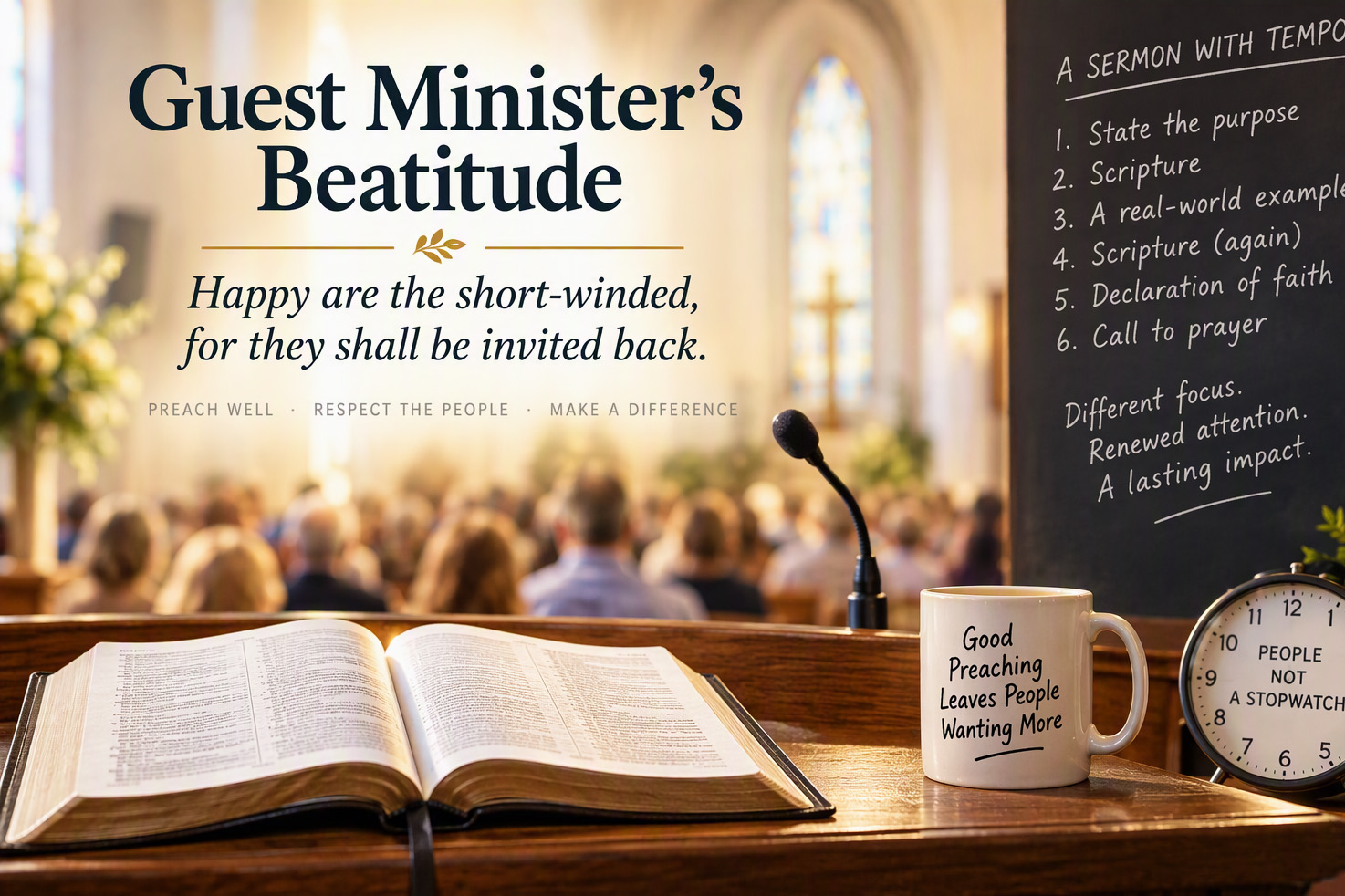
There is an unofficial beatitude that every guest minister would do well to remember:
Happy are the short-winded, for they shall be invited back.
It usually produces a smile, particularly among people who have sat through a sermon that appeared to have several endings.
But behind the humour lies an important lesson about preaching as a guest.
When you are invited to preach in someone else’s church, you have been entrusted temporarily with a congregation that another minister and leadership team serve week after week. You are not there to take possession of the pulpit. You are there to contribute something worthwhile and then hand it back.
That means respecting the congregation, respecting the church, respecting the minister who invited you and, importantly, respecting people’s time and capacity to listen.
The word guest matters.
Every church has its own rhythm. The congregation knows that rhythm even if nobody has written it down. They know roughly when the service begins and finishes, how worship normally flows, how long the sermon usually lasts and what happens afterwards.
A visiting minister who ignores that rhythm can unintentionally disrupt far more than the order of service.
People may have children to collect. Volunteers may have responsibilities following worship. Musicians and technical teams may have other commitments. Some people may depend on public transport. Others will simply have planned their day around the normal pattern of the church.
Going substantially over time is therefore not necessarily evidence of spiritual enthusiasm.
Sometimes it simply means you have forgotten that you are a guest.
This is perhaps one of the simplest lessons for a guest minister.
If you are given 30 minutes to preach, you do not receive a prize for finishing at exactly 29 minutes and 59 seconds.
If the message is complete after 25 minutes, finish after 25 minutes.
Do not add another anecdote because you have time available. Do not introduce another passage of Scripture simply because it supports something you have already established. Do not repeat the conclusion three different ways.
And be very cautious about saying:
“One final thing…”
Particularly if you have already said it twice.
A sermon should be as long as necessary to communicate its message well, not as long as the available slot permits.
There is considerable skill in knowing when you have finished.
There is an important distinction here.
Many sermons last 30 or 40 minutes. That does not necessarily mean asking a congregation to concentrate on precisely the same thing, in precisely the same way, for 40 minutes.
Good preaching has a tempo.
A minister might begin by stating the purpose of the sermon:
Why are we talking about this today?
That may be followed by Scripture, moving the congregation from listening to an introduction towards considering the biblical foundation of the message.
Then comes a real-world example or story. The mode changes again. People are no longer dealing principally with an abstract idea or biblical text. They are imagining a situation, seeing how the message applies and relating it to their own experience.
The preacher may then return to Scripture, perhaps introducing another passage or connecting several biblical references. The congregation is being invited to reconsider the real-world example in the light of Scripture.
From there the sermon may move towards a declaration of faith:
This is what we believe.
This is what this means for us.
This is how we should respond.
Finally comes the call to prayer. Once again, the nature of people’s attention changes. The congregation is no longer simply listening to the minister. People are being asked to respond personally and spiritually to what they have heard.
So there is a natural rhythm:
Purpose → Scripture → Real life → Scripture → Faith → Prayer
Each section has a purpose.
And each transition changes the congregation’s focus.
There is a frequently repeated idea that adults have an attention span of around 10, 15, 18 or 20 minutes. The research is actually much less definitive. Reviews of the evidence have specifically questioned the idea that human attention simply falls off a cliff after a predetermined number of minutes.
Research does, however, give us good reason to take sustained attention seriously. Experimental work involving a 40-minute lecture found that mind-wandering increased over time while retention of the material declined.
For the preacher, therefore, the lesson is more interesting than:
“People can only listen for 20 minutes.”
It is:
Don’t ask people to listen in the same way for 40 minutes.
A strong sermon contains changes in pace, intellectual focus and emotional engagement.
These transitions renew attention because the congregation is being asked to do something slightly different.
The preacher isn’t simply filling time. The preacher is taking people somewhere.
This is where experienced preaching can appear effortless.
The congregation may not consciously notice the structure at all.
They simply know that the sermon seemed to flow.
There was movement.
There was a destination.
This is why an engaging 35-minute sermon can sometimes seem considerably shorter than an unstructured 20-minute sermon.
The difference isn’t simply the clock.
It is tempo.
If someone speaks for 20 minutes in essentially one mode, with no change of pace, no narrative movement and no clear destination, 20 minutes can feel very long indeed.
Conversely, a longer sermon can sustain attention when each section naturally leads to the next.
But there is a warning here, particularly for the guest minister.
The danger isn’t necessarily that the sermon is too long.
The danger is that each component becomes too long.
The introduction becomes ten minutes.
One biblical reference becomes a theological excursion.
The real-world example becomes another sermon in its own right.
Then comes another passage of Scripture because it is interesting.
And another.
The declaration of faith becomes a second conclusion.
The second conclusion produces a third conclusion.
Then finally:
“Before we pray, I just want to say one more thing…”
A carefully structured 30-minute sermon has quietly become a 50-minute sermon.
The solution isn’t to speak faster.
It is to understand what each section is there to accomplish.
Once it has accomplished that purpose, move on.
Guest ministers can be particularly susceptible to trying to say too much.
Perhaps you only visit that congregation occasionally. You may have spent considerable time preparing. You may know far more about the subject than can reasonably be communicated in one sermon.
That’s fine.
You don’t have to tell them everything you know.
Before preparing the sermon, ask yourself a simple question:
If people remember only one thing from this sermon tomorrow morning, what should it be?
Once you know the answer, construct the sermon around it.
Everything else has to earn its place.
A biblical reference should strengthen the message.
An illustration should illuminate it.
A personal story should make it real.
An application should make it relevant.
A declaration should make the position clear.
Prayer should allow people to respond.
If something doesn’t contribute to that journey, ask whether it needs to be there.
A short sermon is not necessarily a shallow sermon.
And a long sermon is not necessarily a profound one.
Depth comes from insight, preparation, understanding of Scripture and the ability to communicate something meaningful.
Length merely tells us how long you spoke.
Indeed, preparing something concise can require considerably more discipline because you have to identify what really matters.
The objective is not to demonstrate how much you know.
It is to give the congregation something worth remembering.
Preaching is communication, and communication requires more than speaking.
Pay attention to the people in front of you.
Are they engaged?
Are they following you?
Has the room become restless?
Have you already landed the point that you are still explaining?
Sometimes the congregation knows that the sermon has finished several minutes before the preacher does.
Learning to recognise that moment is an important part of preaching.
Once the message has landed, let it land.
Silence can sometimes accomplish more than another five minutes of explanation.
There is another practical reason for all of this.
Someone trusted you with their pulpit.
Make their decision easy to defend.
A guest minister who arrives prepared, understands the congregation, respects the character and traditions of the church, stays within agreed boundaries and leaves people with something worthwhile is remarkably easy to invite again.
One who transforms a 30-minute invitation into an hour creates a rather different pastoral problem.
The congregation notices.
The leadership notices.
And the minister who invited you almost certainly notices.
There is a simple principle in communication: it is better to leave people wanting a little more than wishing there had been rather less.
That does not mean rushing.
It does not mean making sermons superficial.
And it certainly does not mean that every sermon has to end after 18 or 20 minutes.
It means understanding attention.
It means understanding tempo.
It means respecting the people listening to you.
And, above all, it means knowing where you are taking them.
And when you have finished…
finish.
Which brings us back to that unofficial Guest Minister’s Beatitude:
Happy are the short-winded, for they shall be invited back.
Short-winded doesn’t necessarily mean short.
It means knowing what needs to be said, saying it well and recognising when it has been said.
And perhaps that is why the line makes congregations laugh.
Like much good humour, there is just enough truth in it to make the preacher slightly uncomfortable.