 11
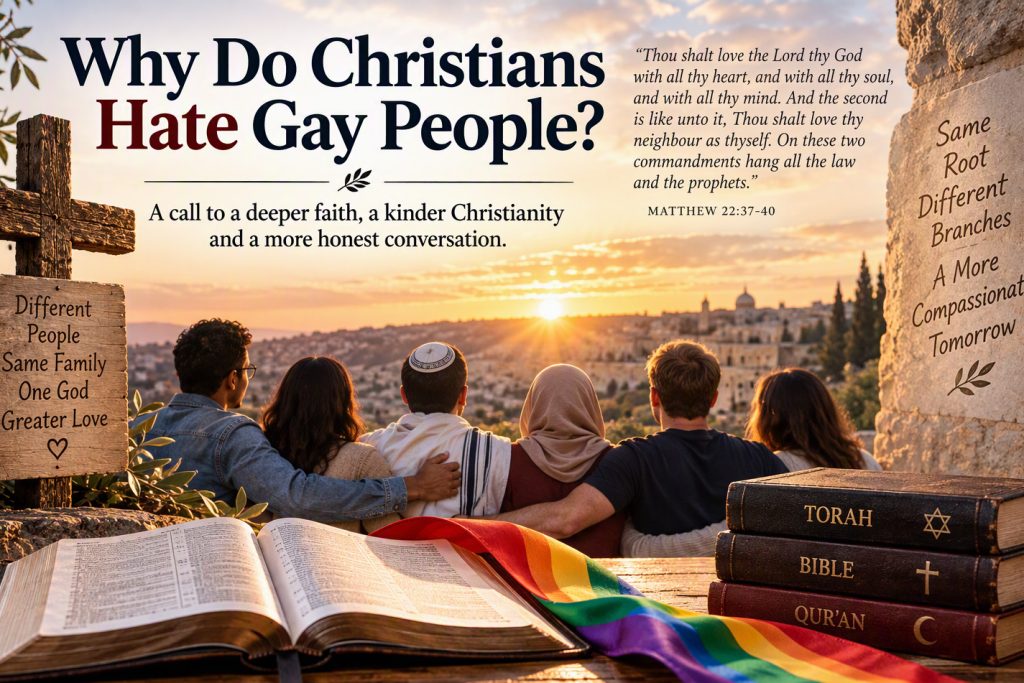
For all the hostility that sometimes exists between Jews, Christians and Muslims, there is an uncomfortable truth we can easily forget:
We are not strangers to one another.
Our histories are intertwined.
Our faith traditions disagree, sometimes profoundly, about theology, revelation and the identity of Jesus. Those differences are real and should not be disguised in the interests of creating a comfortable interfaith story.
But disagreement does not erase relationship.
Jews and Muslims both understand their religious histories through Abrahamic family lineages, while Christianity emerged from Judaism and brought Gentile believers into a story that had already existed for generations.
For Christians especially, that should give us pause.
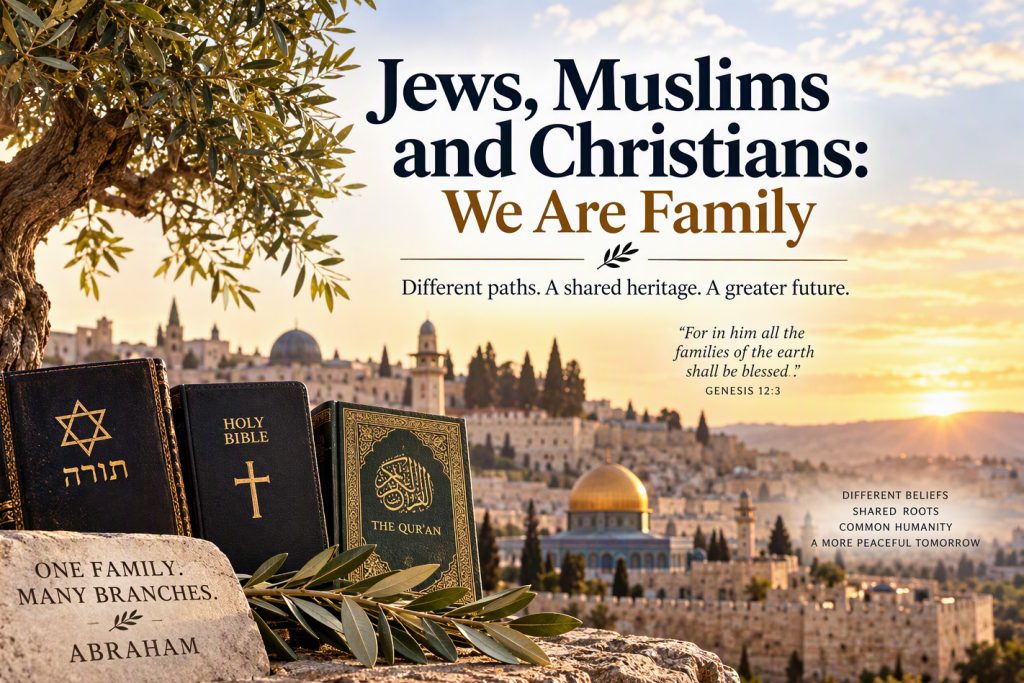
Abraham stands near the beginning of a family story that would profoundly shape Judaism, Christianity and Islam.
Jewish tradition traces the covenantal story through Abraham, Isaac and Jacob.
Islam also places Abraham, or Ibrahim, at the heart of its religious history, with Ishmael occupying a particularly important place in the Islamic ancestral tradition.
Academic study of early Islam has likewise argued for the importance of descent from Abraham through Ishmael to the Qur’an’s understanding of the community surrounding Muhammad.
So Judaism and Islam do not emerge from completely unrelated religious worlds.
They encounter Abraham through different lines and understand the significance of those lines differently, but Abraham stands within both traditions.
That makes the language of family particularly powerful.
Families can disagree.
Families can become divided.
Families can even spend generations fighting over inheritance.
They do not cease to have a shared history simply because they disagree about what that history means.
Christianity enters this story differently.
Jesus was Jewish.
The earliest followers of Jesus were Jewish.
The Hebrew Scriptures became part of the Christian Bible.
Christian ideas about creation, covenant, prophecy and Messiah cannot be separated from the Jewish world from which Christianity emerged.
But as Christianity expanded beyond its Jewish beginnings, enormous numbers of Gentiles entered the faith.
And the Apostle Paul uses a remarkable image to explain what has happened.
He describes Gentiles as wild olive branches grafted into an existing cultivated olive tree.
That image matters.
The Gentile Christian does not plant the tree.
The Gentile Christian does not become the root.
The Gentile Christian is grafted in.
Paul even warns Gentile believers against becoming arrogant towards the natural branches, reminding them that they do not support the root. The root supports them.
That is an extraordinary warning when viewed against Christianity’s later history.
There is something deeply contradictory about Christian antisemitism.
How can Christians hate Jewish people while claiming a faith whose Messiah was Jewish?
How can Christians despise Judaism while reading Jewish Scripture every Sunday?
How can Gentile Christians claim superiority over the very people whose religious history forms the root into which Christianity says they have been grafted?
Paul’s metaphor leaves remarkably little room for that arrogance.
We are the wild branches.
For most Gentile Christians, our connection to the Abrahamic covenantal story does not arise from claiming Jewish ancestry.
It comes through faith.
We were brought into a story that wasn’t originally ours.
That should produce gratitude.
And it should produce humility.
Muslims are sometimes treated in Christian political rhetoric as though Islam emerged from an entirely alien civilisation with no connection whatsoever to the world of the Bible.
But Islam also looks towards Abraham.
Islamic tradition gives both Abraham and Ishmael important roles in its understanding of sacred history.
That doesn’t make Islam and Judaism the same religion.
It doesn’t make Christianity and Islam the same religion either.
The differences are substantial.
Christians believe things about Jesus that Jews reject. Muslims honour Jesus but understand him very differently from Christians. Judaism, Christianity and Islam have developed distinct scriptures, traditions and understandings of God.
We do not need to pretend those differences don’t exist.
We simply need to stop pretending that theological difference requires human hostility.
Perhaps one of the problems with religious conflict is that we think recognising another tradition somehow weakens our own.
It doesn’t.
A Christian doesn’t stop being Christian by acknowledging the Jewish foundations of Christianity.
A Jew doesn’t stop being Jewish because Christianity emerged from Judaism.
A Muslim doesn’t stop being Muslim by acknowledging profound theological disagreements with Christians and Jews.
We can acknowledge difference without manufacturing hatred.
And we can recognise shared history without pretending there is shared theology where there isn’t.
That distinction matters.
Perhaps there is a simpler way of looking at this.
Three religions can argue about the inheritance without forgetting that they are arguing about the same family.
Abraham matters to all three.
The interpretation of Abraham differs.
The understanding of covenant differs.
The understanding of Jesus differs enormously.
The scriptures differ.
The theology differs.
But those differences shouldn’t blind us to the extraordinary historical and religious connections between these traditions.
For a Christian, this should be particularly difficult to ignore.
We cannot simultaneously celebrate being children of Abraham through faith and then behave as though the other people connected to the Abrahamic story are inherently our enemies.
This returns us to a larger problem.
There are political movements that benefit from division.
There are extremists who need us to think in terms of us and them.
There are people who find it useful to tell Christians that Jews are the problem.
Others tell Christians that Muslims are the problem.
Some tell Jews that Muslims are the problem.
Some tell Muslims that Jews or Christians are the problem.
Fear simplifies a complicated world.
Faith should make us capable of something better.
We can disagree.
We can debate theology.
We can defend our beliefs.
We can say plainly that we think another religion is wrong about something.
None of that requires hatred.
None of it requires dehumanisation.
And none of it requires violence.
For Christians there is an especially uncomfortable question.
If we accept Paul’s description of Gentile believers as branches grafted into an existing tree, perhaps we should be rather more careful about deciding who is worthy of our contempt.
We didn’t create the root.
We were grafted onto it.
Perhaps that should change the way we think about religious superiority.
It should certainly change the way we think about antisemitism.
And recognising Islam’s own Abrahamic and Ishmaelite tradition should challenge the idea that Muslims must automatically be regarded as enemies of Christians.
People can disagree profoundly over what Abraham means while still recognising one another’s humanity.
Jews, Christians and Muslims are not one religion.
We should not pretend that we are.
Nor should we reduce complicated populations spread across the world to a single literal biological bloodline.
But our religious histories intersect in ways that make the language of inevitable religious hatred extraordinarily difficult to justify.
Jews inherit an ancient Abrahamic covenantal tradition.
Muslims understand themselves within an Abrahamic tradition in which Ishmael has an important place.
And Gentile Christians?
Paul tells us exactly what happened to us.
We were grafted in.
Perhaps Christians need to remember that more often.
Because if your Christianity teaches you to hate the people whose family story you were grafted into, perhaps the problem isn’t their religion.
Perhaps you have forgotten the roots of your own.